Healthy Materials Lab EU: Projects
Re-Generation, Restoration, Resilience: Design Proposals
Trbovlje, Slovenia 2026-present
How can an abandoned site shaped by extraction, become a catalyst for regeneration, material health, and community resilience?
Across Europe, former industrial landscapes are being re-imagined as spaces for healing and innovation. In Slovenia, one such site, a decommissioned coal power plant, is becoming a testing ground for new ideas about restoration, resilience, and design.
For decades, the Thermal Power Plant (TET) in Trbovlje fueled Slovenia’s energy needs while blanketing the valley in sulfur dust, smoke, and toxic emissions that polluted the air, water, and soil. Heavy metals from the burning process were deposited in the surrounding landscape, and for many years, life in the valley struggled to survive under this toxic haze. Since the plant’s closure, however, the local ecosystem has begun to recover. Vegetation has returned to the riverbanks, air and water quality have improved, and wildlife has started to reappear. This recovery is a powerful local example of how moving away from fossil fuels can support the restoration of ecosystems and biodiversity.
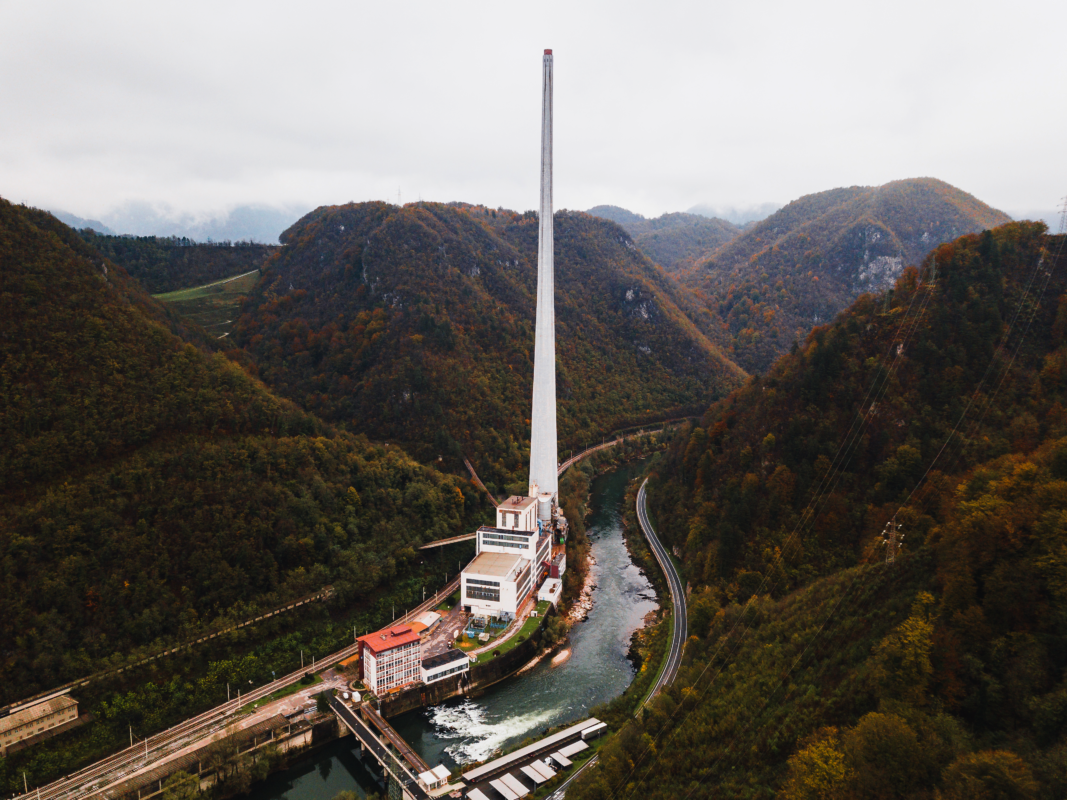
Project Site
Parsons Healthy Materials Lab and HML EU are engaging the TET site as a case study for regenerative design, adaptive reuse, and healthier material futures. Working in collaboration with local partners, including Non Tox Uni Kum, the Municipality of Trbovlje, and local community members, the Parsons Slovenia Studio invited students to study the site’s ecological conditions, industrial legacy, and community aspirations.
The adaptive reuse of existing industrial infrastructure offers multiple benefits for human and planetary health, including reducing embodied carbon emissions; conserving materials and natural resources; minimizing construction waste; preserving existing landscapes; and creating opportunities for ecological restoration.
Through this work, students proposed architectural interventions for the power plant and its surrounding landscape. Their proposals ask how design can help transform a site shaped by extraction and pollution into a place of repair, public life, and regenerative possibility.
The following provides an overview of the research, ideas, and design proposals developed throughout the studio, serving as a starting point for further exploration into how post-industrial landscapes can be transformed through strategies of material circularity, phytoremediation, and reprogramming.
RESEARCH: ENERGY PRODUCTION IN SLOVENIA
Historically, energy production in Slovenia was closely linked to coal-mining regions as well as hydropower infrastructure. Trbovlje is a clear example of this relationship: its first coal-fired power station opened in 1915, while a larger thermal power plant was built between 1964 and 1968 and commissioned in 1966. Fueled by coal from the nearby Trbovlje-Hrastnik mine, the plant tied mining labor, electricity production, and industrial growth to the Zasavje region. As coal production declined and the mine entered a long closure process, the Trbovlje power plant also ceased operation, leaving the site as part of Slovenia’s post-industrial energy landscape.
CONTEXT: TET POWER STATION, TRBOVLJE
The Trbovlje Thermal Power Plant, known as TET, was a lignite-fired power station on the Sava River in Slovenia’s Zasavje region. For decades, the plant connected coal extraction, electricity production, and industrial labor in the Trbovlje-Hrastnik mining region. Now inactive, the site represents a major post-industrial infrastructure with potential for adaptive reuse, ecological repair, and new public or cultural programs.
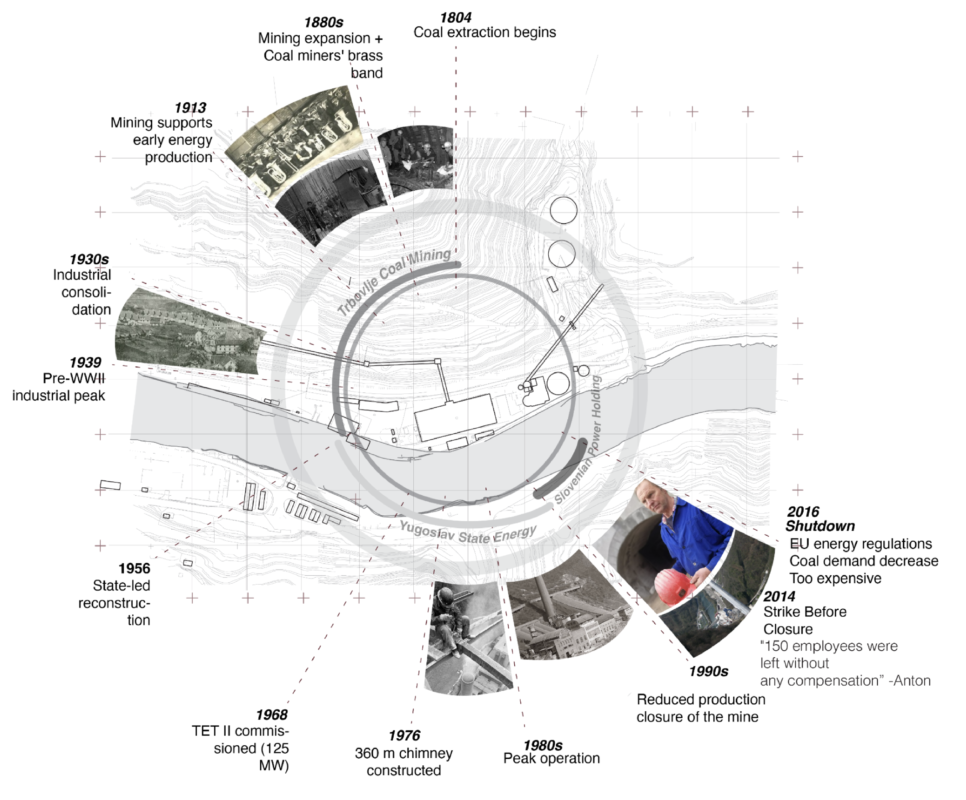
Site Timeline
STRATEGY: Re-Generation, Restoration, Resilience
Through strategies of material circularity, students explored how concrete, steel, old machinery and other on-site elements can be reused in new architectural and landscape systems. Phytoremediation, wetlands, and planting strategies address the site’s environmental legacy, proposing a gradual process of soil and water repair. At the same time, community-based programs, such as cultural spaces, workshops, gardens, libraries, and gathering areas, open the site back to the public.
Together, these proposals envision a new life for the TET Power Station.
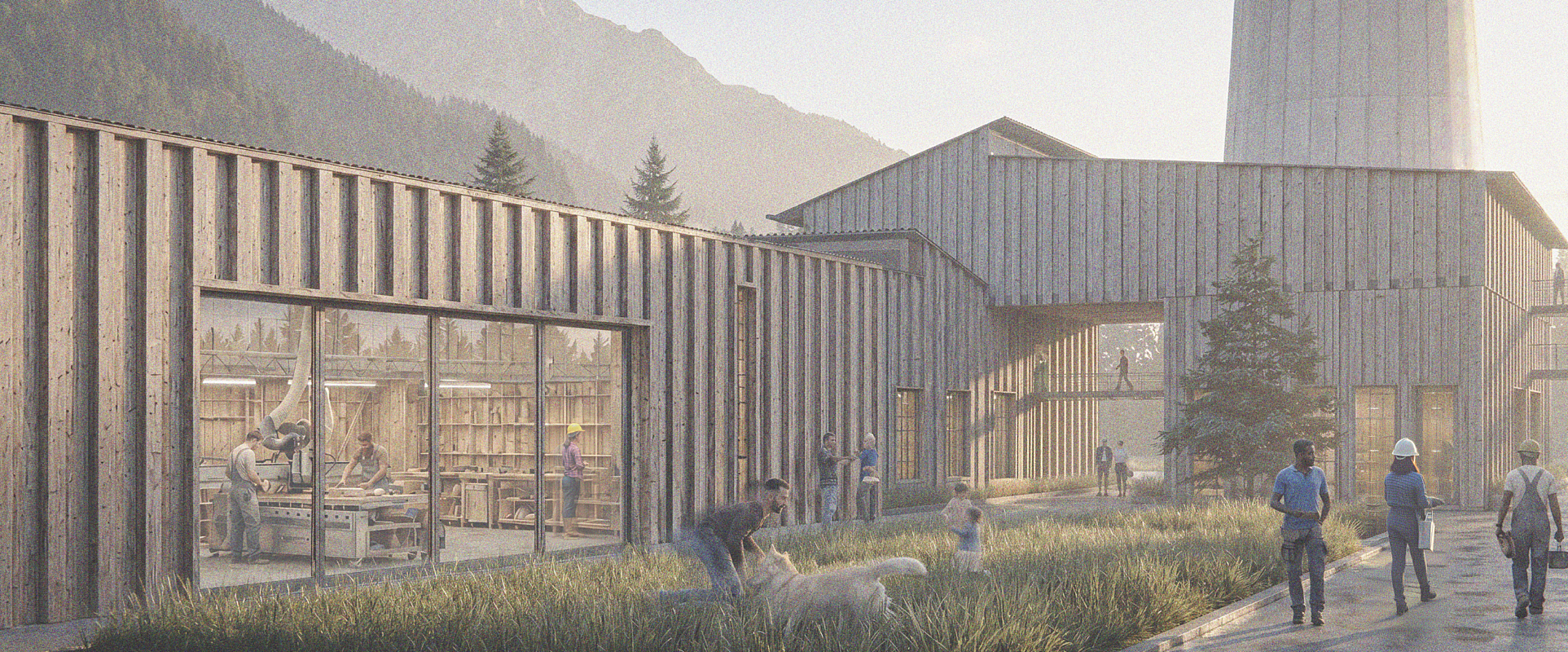
“The Research Hub” project proposal rendering. Image Credit: Sarthak Kothari
STUDENT DESIGN PROPOSALS
Following is an excerpt from three design proposals. For more projects, please refer to the downloadable pdf and related blog posts below.
TET TECHNICAL SCHOOL, Anna Carolinna Costa
A RE-IMAGINED LANDSCAPE
This project re-imagines the former power plant as a technical school focused on mining technology, environmental remediation, and energy systems. After the closure of several mines, hundreds of workers lost their jobs without compensation, leaving behind an empty power plant and a community that no longer had the industry it was built around. This technical school proposes to draw from the site’s history to create new opportunities for the community.
Spatially, a network of elevated pathways is introduced throughout the site, redefining circulation while creating space beneath the walkways for phytoremediating plants to grow and restore the landscape.
Additionally, three wooden mesh systems extend through the building and landscape, each representing a different layer of the project: phytoremediation, industrial history, and geothermal energy. Together they connect the school to the surrounding landscape and make visible the processes of restoration, education, and energy production that are shaping the site’s future.

A network of elevated paths is woven through the site and existing structures, creating a continuous promenade and belvedere above a planted groundscape of restorative flora and fauna. Image Credit: Costa

Section through Main Hall. Image credit: Costa

Project Collage. Image credit: Costa
BLACK DUST & BALLET, Anais Marechal
A CENTER FOR PERFORMANCE
This project proposes the adaptive reuse of the site into a Ballet House and performance space.
Architecturally, the design contrasts the heavy existing materials of the power plant, including concrete, brick, and steel, with the lightness, suspension, and movement associated with ballet.
Existing steel catwalks, metal screens, and concrete columns are retained, while new glulam and CLT insertions create spaces for dance studios, auditoriums, an arts library, exhibition space, and a material bank for reclaimed materials.
Phytoremediation, wetlands, bioswales, and landscape interventions address the site’s industrial pollution. Through adaptive reuse, material reclamation, and human-scaled programming, the project transforms a former energy-producing site into a cultural space centered on movement, performance, and renewal.

Project rendering. Image credit: Marechal

Section through Main Hall. Image credit: Marechal

Material Bank. Image credit: Marechal
THE CIRCULAR VILLAGE, Hiya Patel
A COMMUNITY ON THE WATER
This project transforms the former power plant into a self-sustaining housing village rooted in adaptive reuse, healthy living, and community-centered design.
Rather than erasing the site’s industrial history, the proposal preserves its existing infrastructure and material identity while transforming it into spaces for living, gathering, growing, and belonging.
Organized around circular living systems, the village integrates housing, small-scale agriculture, green energy, healthcare, childcare, local grocery spaces, and community workshops.
A range of housing typologies supports intergenerational and communal living, while modular wood units with hemp batt insulation introduce lightweight, sustainable structures within the heavier industrial framework. Through reuse, shared resources, and adaptable public spaces, the project transforms a former energy-producing site into a resilient framework for everyday life.

Interior rendering. Image credit: Patel

Housing Section. Image credit: Patel

Material Circularity Diagram. Image credit: Patel
The full studio report includes research and all design proposals. Download it here.
FACULTY: Alison Mears and Angela Zeit
COLLABORATORS: Project led by HML EU in collaboration with the Municipality of Trbovlje and Petra Marinko, founder of Non Tox Uni Kum.
STUDENTS: Anais Marechal, Anna Carolinna Costa, Ariana Miyasato, Caitlin Murnane, Elizabeth Sever, Hiya Patel, Madelyn Yu, Riley Kendall, Sarthak Kothari, Shekhar Pillai
Join Our Academic Network
Get Access to our carefully researched and curated academic resources, including model syllabi and webinars. An email from an academic institution or a .edu email address is required. If your academic institution does not use .edu email addresses but you would like to join the network, please contact healthymaterialslab@newschool.edu.
Already have an account? Log in