Manufactured homes provide affordable housing for nearly 22 million Americans, representing a vital piece of the nation’s housing landscape, especially for rural areas.
With the manufactured housing market projected to grow significantly in the coming decade, the health and sustainability implications of commonly used materials need close scrutiny.
Most modern manufactured homes are built using petroleum-derived plastics for floors, walls, ceilings, and cabinetry. Materials like luxury vinyl tile (LVT), PET carpets, and acrylic latex paints dominate interior surfaces.
Over time, these products emit volatile organic compounds (VOCs) and other hazardous chemicals, impacting indoor air quality and increasing the risk of asthma, cancer, developmental disorders, and other health issues.
These concerns are especially pressing for marginalized and low-income communities, who are often most exposed to such hazards.
The environmental costs are just as stark. The building sector is the second-largest global user of plastics, nearly all of which are derived from fossil fuels, making it a significant contributor to carbon emissions. Even conventional insulation materials like fiberglass add to the industry’s carbon footprint.
THE REPORT: MATERIAL ANALYSIS
Manufactured Homes: An Analysis of Health and Environmental Impacts of Common Building Materials examines how common building materials used in manufactured homes affect indoor air quality, human health, and embodied carbon.
Using detailed material analysis, the report quantifies plastic content, toxic chemicals, and global warming potential while identifying healthier, low-carbon alternatives for more sustainable affordable housing.
The analysis found that a typical manufactured home can contain over 1,400 kg of toxic ingredients across its materials, many linked to health hazards such as cancer and endocrine disruption.
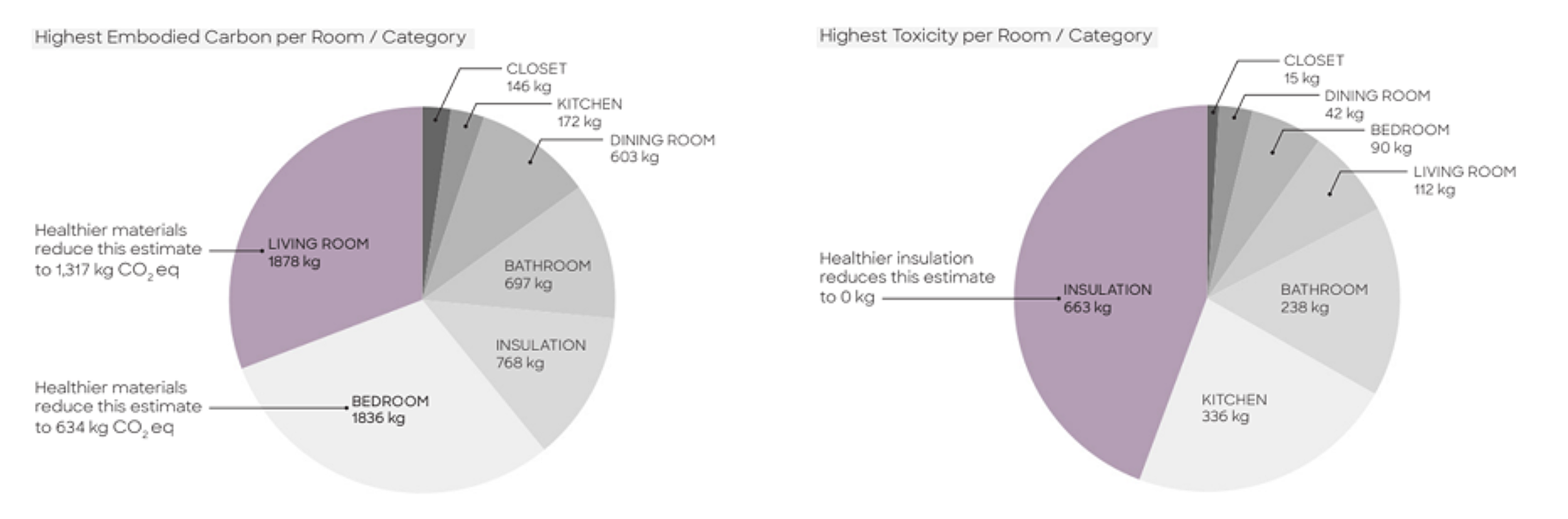
Embodied carbon + toxicity by room type, Manufactured Homes: An Analysis of Health and Environmental Impacts of Common Building Materials, 2025.
Drawing on material documentation and comparative analysis, the report uncovers key trends shaping the health and environmental impacts of manufactured housing. Highlights include:
- Why petrochemical-based plastics dominate manufactured home construction
- The toxic chemical burden found in common interior building materials
- How material choices affect indoor air quality, occupant health, and embodied carbon
- Why these exposures disproportionately impact low-income and rural communities
- Material substitutions that can reduce toxic chemicals while lowering carbon emissions
- Actionable insights to help manufacturers, developers, and policymakers make healthier material decisions
As demand for manufactured housing continues to grow, the materials used to build these homes will shape the health of millions of residents and the industry’s climate impact.
By making material choices more transparent, this report provides a practical foundation for designing and delivering healthier, lower-carbon affordable housing.
Manufactured Homes: An Analysis of Health and Environmental Impacts of Common Building Materials was supported by a grant from The 11th Hour Project, a program of the Schmidt Family Foundation.
Join Our Academic Network
Get Access to our carefully researched and curated academic resources, including model syllabi and webinars. An email from an academic institution or a .edu email address is required. If your academic institution does not use .edu email addresses but you would like to join the network, please contact healthymaterialslab@newschool.edu.
Already have an account? Log in