The concept began with a question:
What if we treated materials the way we treat food - with care, curiosity, and conversation?
The long table was the focus of the space and defined how the story unfolded. Across cultures, it is where we gather, break bread, exchange stories, and build trust.
And at Ambiente 2026 in Frankfurt, it became a place to reflect on the materials that shape our homes, cities, and health - and how in this, Nature is our best partner.
Invited by the Ambiente team, Alison Mears and Leila Behjat from HML EU together with Silke Remmel from raumgesichte developed At the Table With Nature - a space that invited visitors to slow down in the midst of a global consumer goods fair - and examine what lies beneath the surface of design.
Over five days, more than 25 languages were spoken at our table - German, English, French, Spanish, Italian, Turkish, Korean, Japanese, Lithuanian, Ukrainian, Polish, Dutch, Swedish, Arabic, and many more. The diversity of voices reflected a shared urgency: a desire to build differently.
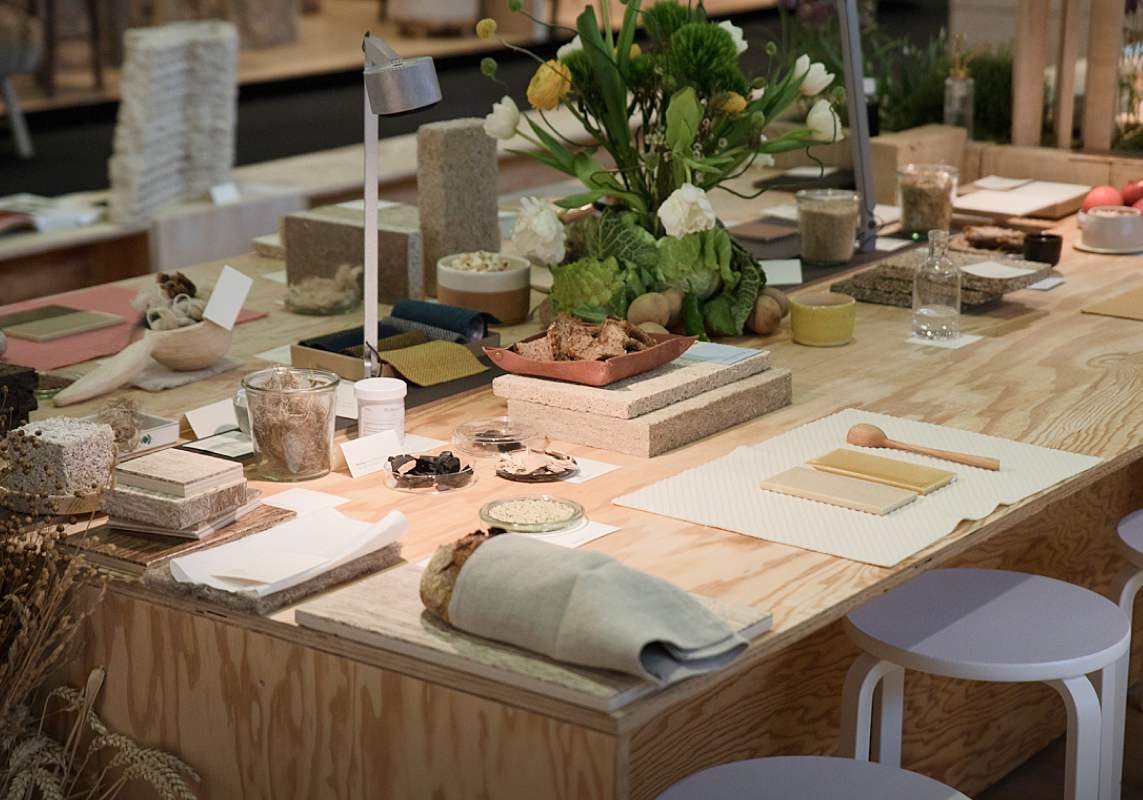
Setting the Table - Booth Design
We knew from the outset that the booth itself had to embody the change we advocate.
Before placing any samples on the table, we focused on the materials that formed the space:
- Hemp-lime panels as the back wall
- Clay plasters and mineral finishes
- Cork, recycled leather, and biobased surfaces
- Mushroom-grown elements integrated into the central B1 Multiplex sculpture
- Reused furniture from Messe Frankfurt’s Fundus, retrofitted with healthy material fronts
- Resilient Flooring from plant-based oils
- Porcelain dishes with waste-derived glazes
- Pigments from biochar
Raw materials were displayed alongside their finished applications - straw next to panels, hemp beside boards, clay beside plaster - making the transformation from earth to built environment visible and tactile.
We worked closely with craftspeople and collaborators to refine every detail. From the menu for material related snacks (hemp bread, linseed oil infused popcorn, apple chips) as well as the food served during material stories, to the paper and printed materials - selections were made to - reinforce the theme quietly but intentionally.


Material Stories: Daily Conversations
Each day, we hosted MATERIAL STORIES - conversations bringing together Ambiente visitors from all trades as well as architects, designers, manufacturers, and innovators exploring biogenic and low-impact solutions.
We began with The Power of Hemp and Lime, led by Werner Schönthaler of SAPPA Panels - a pioneer of hemp-lime construction in the DACH region and recipient of the German Sustainability Award Products 2026. Werner shared his 15-year journey advancing hemp-based building systems, tracing how a once-niche material is now shaping regenerative architecture at scale. His story was not just technical, but personal - rooted in persistence, innovation, and a belief that nature and performance belong together.
The following day, Regenerative Design Practices invited us into the work of US and French based MAREDI Design with Dijana Savic-Jambert and Marc Jambert. Drawing from a project located in the Loire Valley in France, the studio reflected on how cultural heritage, local craft, and intentional material choices shape healthier interiors. Their presentation reminded us that regeneration is not a style, it is a way of working that honors place, people, and long-term wellbeing.
With Building from the Ground Up, Max Breidenbach of Claytec brought clay to the center of the conversation. He spoke about clay plasters with up to 97% lower carbon than drywall, mineral-based coloration determined entirely by regional geology - without added pigments - and the regulatory work required to shift German building specifications to allow clay systems in contemporary interiors.
The final session, Bioplastic in the Spotlight, expanded the dialogue beyond walls and surfaces to light itself. Dennis Staßen of Wästberg and Sylvia Weigand of XAL explored how lighting design can merge technical precision with material responsibility - from Wästberg’s bioplastic w127 Winkel and recycled aluminum evolution w227 to XAL’s ENIVA suspended aluminum solution. The conversation demonstrated that even highly engineered products can evolve toward transparency, adaptability, and reduced impact without compromising performance.
Across all four sessions, a clear message emerged: healthier materials are no longer experimental. They are market-ready, rigorously tested, aesthetically refined - and increasingly demanded.


The Response
Visitors were intrigued by the visual richness of the space but then were intrigued by the sensorial experience - its calm, natural palette, flowers and vegetables, the quiet created by the natural acoustic panels and and the allure of the tactile surfaces. They stayed for the conversations.
We heard:
“Thank you from the planet.”
“It gives me hope for the world.”
“Such a relief to see values beyond rampant consumerism.”
“This place is a goldmine.”
“As soon as I sat down, I knew I was in the right spot.”
Students expressed difficulty finding reliable material information. Designers from Brazil spoke about the challenge of sourcing healthier options. A professor in Berlin shared that this work should inspire the next generation to create new materials.
What emerged was clear: across industries - beyond architecture and design - there is a growing movement toward health, transparency, and regenerative thinking.


The World’s Largest Consumer Goods Fair Creates Space to Reflect on Human and Planetary Health
Ambiente is one of the world’s largest consumer goods fairs. To place a conversation about material health and planetary wellbeing in that context was both intentional and urgent.
At the Table With Nature reframed building not as a purely technical act, but as a cultural one - rooted in care, responsibility, and shared environments.
This installation reminds us all that if we are what we eat, we are where we live.
We leave Frankfurt grateful - for the opportunity, for the collaborators who made this possible, and for the many new relationships formed across borders and disciplines.
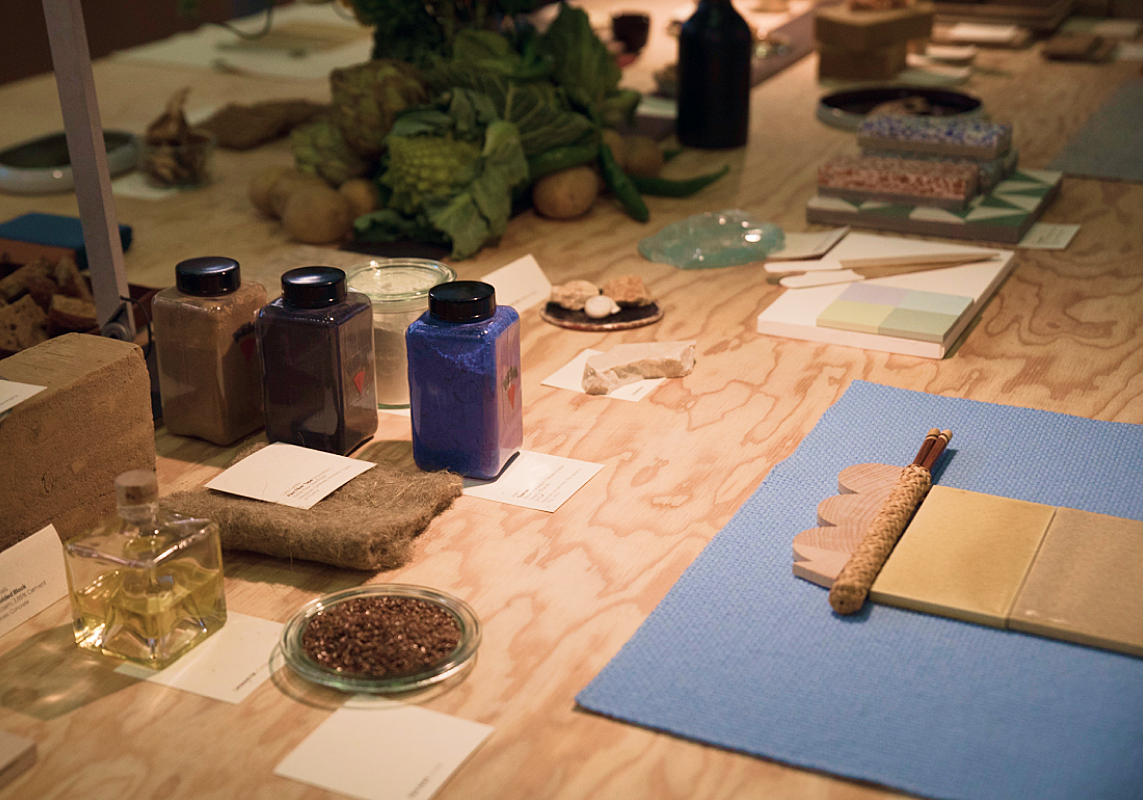


Together with Nature, the table is set and open for all to join.
➡️Discover healthier building products in Material Collections.
➡️Get in touch with HML EU.
Photographs by Jürgen Baumhauer
Read More
Join Our Academic Network
Get Access to our carefully researched and curated academic resources, including model syllabi and webinars. An email from an academic institution or a .edu email address is required. If your academic institution does not use .edu email addresses but you would like to join the network, please contact healthymaterialslab@newschool.edu.
Already have an account? Log in